How to Help Your Child Love Math
- 14. Mai
- 3 Min. Lesezeit
Aktualisiert: 15. Mai
A parent's guide to building math confidence and curiosity in kids aged 5–10 Does your child cringe at math homework? You're not alone. Many parents struggle to help their kids develop a genuine love for numbers and problem-solving. The good news: math confidence isn't something kids are born with—it's something we can build, one small win at a time.

Why Kids Say They Hate Math
Before we fix it, let's understand why so many kids feel anxious about math. Often, it's not the actual math—it's how they've been introduced to it.
• It feels like failure. Kids who struggle with a concept in year 1 often carry that shame forward, convinced they're “bad at math.”
• It's taught in isolation. Numbers feel abstract and pointless when separated from realworld problems kids care about.
• It's presented as rules to memorize. Kids want to understand why, not just what.
• It's competitive. When math is framed as “who's fastest” rather than “who understands,” kids with slower processing feel left behind.
How to Shift the Mindset
1. Celebrate Effort Over Speed
Instead of: “You got it right!” Try: “I loved how you worked through that problem step-by-step.” Kids who hear praise for effort are more likely to embrace challenges. This builds genuine math confidence, not just correct answers.
2. Make Math Real
Point out math in everyday life: cooking, shopping, sports, video games. When kids see math as a tool that solves their problems, it stops being abstract. • “How much allowance will you have after buying that game?” • “If we double this recipe, how much flour do we need?” • “What's your high score divided by 5?”
3. Play Games Instead of Drills
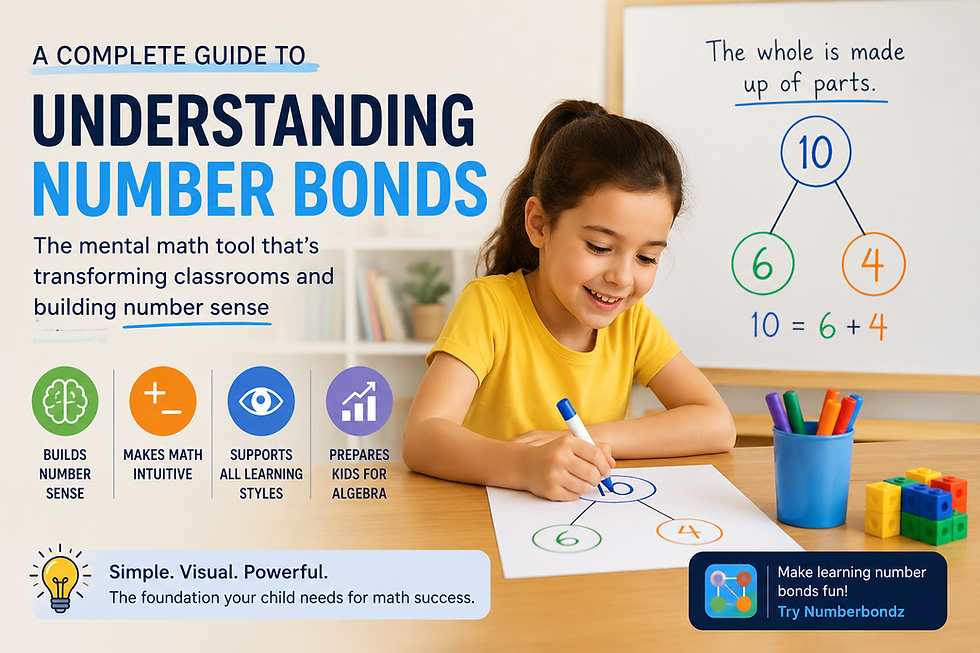
Brain breaks with number games feel like fun, not work. Games like Numberbondz let kids practice mental math through play, building automaticity without the pressure of worksheets.
4. Don't Compare Your Child to Others
Math develops on different timelines. A child who struggles with multiplication at age 7 can excel by age 8 with the right support. Comparison kills confidence faster than anything.
5. Model Mathematical Thinking
Let kids hear you think out loud: “Hmm, I need to figure out the tip. Let me break this down...” Kids absorb the process, not just the answer.
The Power of Play-Based Learning
Research shows that kids learn math fastest when it feels like play. Games engage the reward system in the brain, making learning sticky and enjoyable. When your child plays a math game, they're not thinking “I'm learning.” They're thinking “I'm winning.” But their brain is building number sense, mental math fluency, and problem-solving skills in the background.
A Practical Starting Point
You don't need expensive tutors or fancy curriculum. Start this week:
• Pick one math concept your child struggles with (e.g., addition, number bonds).
• Find or play a game that teaches it (board games, phone games, even dice games work).
• Play together for 10 minutes. That's it. No pressure, just play.
• Notice the difference in their attitude toward math after a few weeks.
Try Numberbondz Free
Speaking of games: Numberbondz is designed by educators to make number bonds feel like an addictive puzzle, not a lesson. Download free on iOS and Android and see how your child engages. You might be surprised at how naturally they start thinking about numbers.
Final Thought
Your child's relationship with math is shaped more by how they learn than what they learn. Build confidence through play, celebrate effort, and watch math anxiety transform into math curiosity.